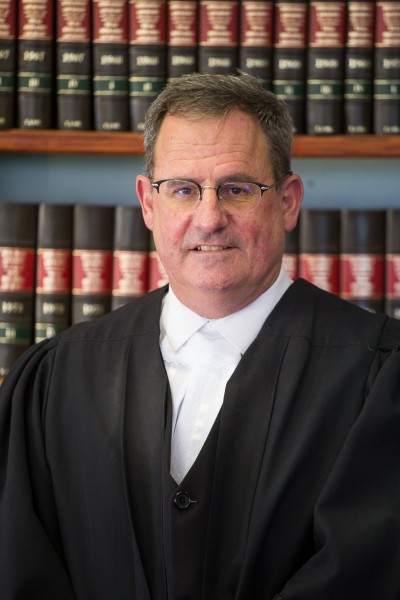
Cape High Court Judge Siraj Desai on 24 December 2019 ruled in favour of press freedom when he denied with costs an urgent application from Afro Fishing in Mossel Bay to gag Mosselbayontheline.
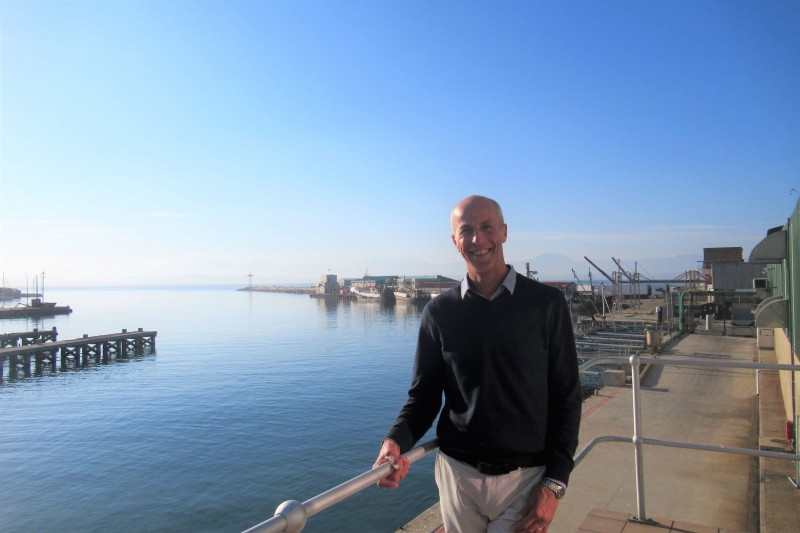
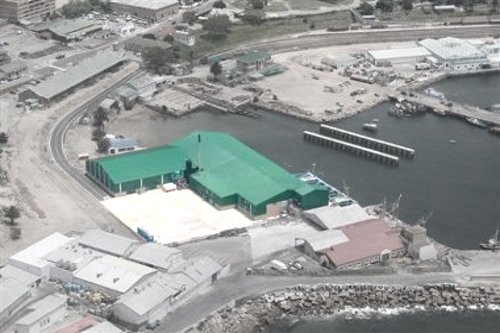
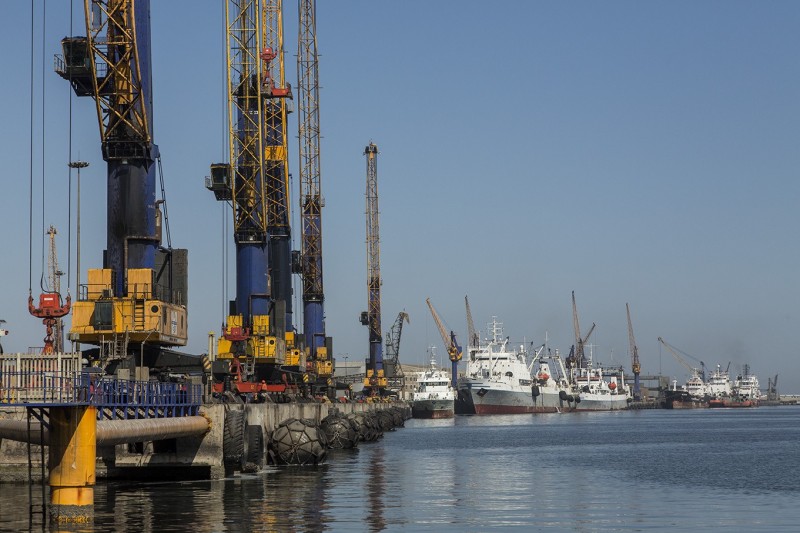
Afro Fishing MD Deon van Zyl on their premises on Quay 1 in the Mossel Bay harbour.
This followed an urgent application brought by Afro Fishing and one of its directors, Johannes Augustinus Breed, to force Mosselbayontheline by means of a high court interdict to remove certain articles from our website and Facebook page pertaining to the ongoing international #fishrot scandal and the connection between Afro Fishing's director /possible shareholder and/or funder connection with the beleaguered Namibian state-owned fishing company Fishcor.
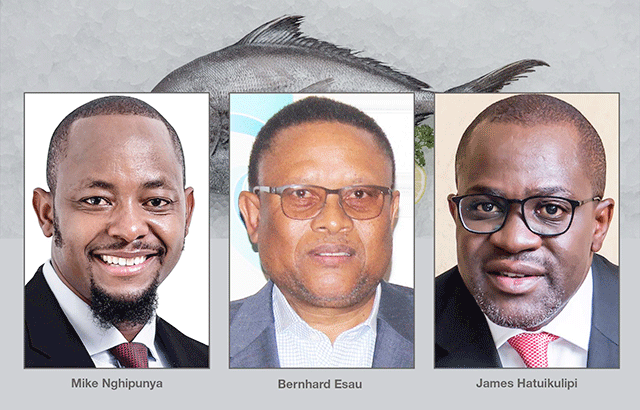
James Hatuikulipi, the former chairperson of the Fishcor board of directors, is one of the so-called #fixrot 6 who was arrested last month on various allegations of fraud, bribery, money laundering, tax evasion and receiving kickbacks worth millions of dollars in exchange for availing Namibian fishing quotas to international companies and business people in the fishing industry. The six, including Namibia's former minister of fisheries Bernhardt Esau and former minister of justice, Sacky Shanghala, are held in custody awaiting trial in February 2020 while the investigation continues.
Mosselbayontheline reported comprehensively in various articles since February 2019 about Afro Fishing's heavily contested application to add a R350 Million fishmeal an oil processing plant to its existing sardine cannery on Quay 1 of the Mossel Bay harbour. We also questioned the inadequate notification and processes followed to duly inform the public of these extensive plans, and the impartiality and professionality of the consultant appointed to perform the public participation process and environmental impact studies.
Afro Fishing's persistent refusal to reveal the names of the new director(s), shareholders and "foreign investors", forced Mosselbayontheline to do our own investigation in order to report that Johannes Augustinus Breed (37) is the only new director appointed after Afro Fishing changed hands in 2017. With the exception of Shamera Daniels, five of the six former long-term directors resigned with the take-over in 2017.
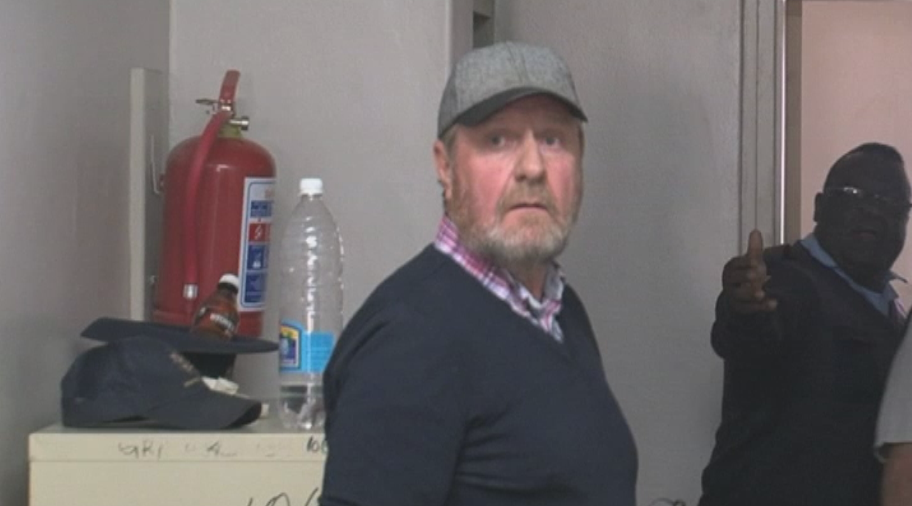
Afro Fishing's two directors, Johannes Augustinus Breed (37) and Shamera Daniels. Photos: Internet
Breed, a chartered accountant, is also a director of eight other South African companies in the fishery industry since 2018. These are Afro Fishing Vessels (Pty) Ltd; Big O Trading 315 CC; K201844187 (South Africa) (Pty) Ltd; Mossel Bay Processors (Pty)Ltd; Mosselbay Pelagic Processors (Pty)Ltd; Princess Brand (Pty)Ltd; Vitoria E Certa (Pty)Ltd and Vitoria Fishing(Pty)Ltd.
Breed is also the managing director of the Angola-based company African Selection Trust (AST) which owns African Selection Fishing Namibia, which in turn has 60% shares in the Namibian company Seaflower Pelagic Processing (Pty)Ltd while Fishcor owns the remaining 40%.
Mosselbayontheline merely quoted leading newspapers in Namibia and elsewhere in which were reported that Breed as well as the South African economist Adriaan Jacobus (AJ) Louw and lawyer Marén de Klerk, represent AST on Seaflower Pelagic's board of directors.
We furthermore quoted articles mentioning that Louw is also the owner of African Selection Fishing (ASF) and that his partnering with Fishcor in 2017 to establish Seaflower Pelagic Processing caused a public outcry because local companies were overseen.
Seaflower Pelagic Processing's directors are the Fishcor board chairperson James Hatuikulipi, Fishcor chief executive Mike Nghipunya, Angolan-based South African accountant Johannes Augustinus Breed, and two other South Africans, economist Adriaan Jacobus Louw and lawyer Marén Brynard de Klerk.
Photo below:Adriaan Louw, Chairperson of the Seaflower Board (third from right), accompanied Pres. Uhuru Kenyatta in March 2019 on a familiarisation tour and visit to the multi-million rand Seaflower Pelagic Processing facility in Walvis Bay during the Kenyan head of state's official visit to Namibia. https://informante.web.na/president-kenyatta-visits-namibias-flagship-fish-processing-facility/
In the light of the ongoing #fishrot investigation and allegations that Fishcor (and AST by implication) received money and a fishing quota worth N$1,8 billion over a 15-year period from the axed Namibian minister of fisheries Bernhard Esau, Mosselbayontheline recommended that Afro Fishing's Public Participation Process be postponed by all relevant authorities, including the Mossel Bay Municipality, until the #fishrot investigation has been completed.
The deadline for the public participation process was 12 December 2019. Mosselbayontheline stated that the public cannot be expected to make calculated and informed decisions regarding such a risky industry if they are not duly informed of all relevant aspects regarding the company, its directors, affiliates, shareholders and financiers, as well as their association with other companies in Angola and Namibia.
Our request entails full disclosure of all links between Afro Fishing in Mossel Bay and other companies in the fisheries industry in Namibia and Angola in which Afro Fishing's directors and/or financiers and shareholders may be directly or indirectly involved. Afro Fishing is in possession of all relevant information and documentary evidence in this regard and is requested to disclose it.
If there is nothing to hide, such full disclosure of all facts, documents and finance-related information can surely prove their innocence, not so?
Mossel Bay Municipality's function in the Public Participation Process
Mossel Bay Municipality has not reacted to this at all to date, as far as we are aware. The municipality, as the local level of government, is subject to the provisions of the constitution and all applicable legislation relevant to this process. It is a public body that is accountable to the Mossel Bay public and indeed the public in general.
We certainly expect a public statement from them in this regard, as well as public assurance that a proper and full investigation into the funding and shareholding of Afro Fishing will be launched. This is easy to do: the directors and shareholders of Afro Fishing should only be required by the Mossel Bay Municipality to file affidavits giving full disclosure of who the shareholders are and where they get their funding from, and also to disclose any possible link to any of the companies involved in the Namibian/Angolan #Fishrot scandal - directly or indirectly.
Should this not be done, it is probable that any approval by the Municipality of Mossel Bay of the application can be taken on review to the high court and be set aside, in which case the municipality might be ordered by the court to pay the expensive legal costs that will have to be incurred to ensure that the municipality performs their functions fully, forensically and transparently.
In Public Interest
Judge Desai's ruling that our articles were not defamatory or malevolent is a welcome break for press freedom and investigative journalism in South Africa where severe budget cuts/constraints in the mainstream printed media caused serious voids in this field. Our alternative defence was, notwithstanding, that the information is factually correct and true, and that it is in public interest that residents have the right to know who Afro Fishing's directors, shareholders and financiers are and what their involvements entail in fishing industries in Namibia, Angola and elsewhere.
Judge Desai has not yet submitted the reasons for his judgment - it will probably be done early in 2020.
Mosselbayontheline is immensely grateful for the sterling performance of our legal team, adv. Theo Nel of the Cape Bar and attorney Hugo van Heerden of Hayes Incorporated in Cape Town who, on very short notice, assisted us in our quest for freedom of the press.
Adv. Theo Nel of the Cape Bar (left) and attorney Hugo van Heerden of Hayes Incorporated in Cape Town.
Also, check our Facebook article and photos of Mossel Bay's pristine beauty and prolific marine life worth preserving:
Ons hoop om die hele vakansie nét vrolike vakansiefoto's te plaas, want niks is lekkerder as om gelukkige mense te sien wat vreedsaam kuier en Mosselbaai se mooi en lekkertes geniet en BEWAAR nie . . . !
BERNHARD Esau, the former Minister of Fisheries and Marine Resources, who along with five others are implicated in the fisheries bribery scandal, was taken to a Windhoek hospital after encountering sudden serious problems with his health while in custody at the Seeis Police Station.
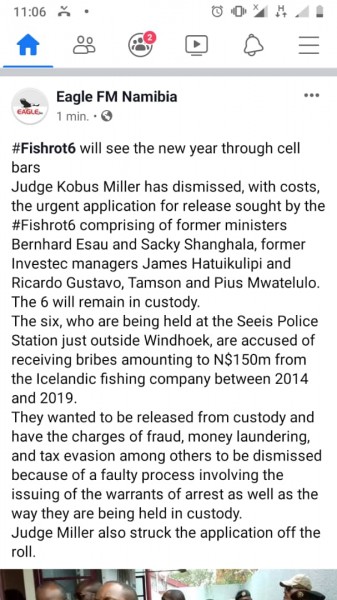
Esau along with former justice minister, Sacky Shanghala, former Fishcor chairperson James Hatuikulipi, Esau’s son-in-law Tamson Hatuikulipi, Investec Namibia manager Ricardo Gustavo and James Hatuikulipi’s nephew Pius Mwatulelo, will enter the New Year in custody after High Court Judge Kobus Miller set aside their application to have the charges against them declared null and void last Friday.
Judge Kobus Miller has dismissed with costs the urgent application brought by the Fishrot six who wanted a court order that would set aside the warrants of arrest, the decision to prosecute them and the decision to postpone their case to 20 February 2020.
The High Court yesterday reserved its judgement in the landmark fishing bribery case, as the accused seek their release from custody on technicalities.
20 December 2019
Six men challenging their arrest on allegations of receiving millions of dollars in kickbacks, in exchange for availing Namibian fishing quotas to an Iceland seafood company, will spend Christmas behind bars after the High Court yesterday reserved its judgment in their urgent application to be released.
Judge Kobus Miller indicated he would deliver his judgement on 27 December, dashing any hopes former ministers Bernhardt Esau and Sacky Shanghala had of spending Christmas with their families.
The unlawful warrant stems from the arrest of former fisheries minister Esau, who was released from custody on a Sunday after the state and his lawyers agreed that the warrant was illegal.
South African advocate Thembeka Ngcukaitobi argued that when Esau was re-arrested with his co-accused, “no new facts have been produced”.
“Instead, the affidavit in support of the warrant of 26 November regurgitates the affidavit of 23 November 2019. This leaves the inescapable conclusion that the application of 26 November was simply a trick to circumvent the order of 23 November 2019,” Ngcukaitobi said.
He said the allegations in the affidavit used for the arrest warrants did not set out a convincing basis for the need to arrest the applicants, and the officials had not disclosed that the investigations had been ongoing since 2014.
“In none of the affidavits filed in support of the application of the warrants of arrest is any allegation made for the case that it was necessary particularly at this stage to arrest the applicants,” Ngcukaitobi said.
In his view the respondents had not shown that arresting the accused was the only way to ensure their attendance at court, and therefore the arrest warrants were unlawful.
The six accused are Esau, Shanghala, former chairperson of the Fishcor board of directors James Hatuikulipi, Tamson Hatuikulipi, Ricardo Gustavo and Pius Mwatelulo. They were not at court yesterday.
Advocate Piet van Wyk, who argued on behalf of the state, insisted yesterday that the urgent application by the Fishrot Six to have their arrest warrants set aside was baseless.
Van Wyk argued that the application had no urgency and that the applicants would be afforded substantial redress in the normal course of the legal process.
“This we say that the redress here includes the avenue to enrol their abandoned bail application and that, should the criminal trial eventuate, they may raise all the concerns they have with regard to the warrants of arrest,” he said.
Judge Miller, who reserved judgment on the matter until 27 December, asked Van Wyk why there would be a need for a bail application if the warrants were unlawful in the first place.
Van Wyk said in his view the warrants were lawful and the applicants had recourse to other routes if they want to regain their liberty.
“Urgency is a condition imposed by reasons of circumstances beyond his or her control. It is thus our contention herein that this matter is in no way urgent, in that the applicants from their papers filed of record herein do not at all allege nor explain which conditions, if there is one, nor do they explain any facts or circumstances beyond their control. This apparent absence of what they ought to have explained has indeed a consequence that this matter stands to be dismissed,” said Van Wyk.
He also said the applicants must explain why their application was delayed until now.
Van Wyk also responded to Ngcukaitobi, who had said there was no indication why the warrants for the arrest of his clients had been necessary.
“The Windhoek magistrate, as is also set out in his affidavit, fully complied with these jurisdictional requirements to authorise the warrants of apprehension and the relief sought in this application should be dismissed with costs,” Van Wyk said.
Impermissible
Ngcukaitobi suggested that the second arrest warrant issued on 27 November was replicated from the initial warrant issued on 23 November, and that amounted to contempt of court.
“This is impermissible,” he said.
Ngcukaitobi argued that if a warrant was set aside, it would be acceptable to apply for a second time but that should be based on new facts.
“No new facts have been produced. Instead, the affidavit in support of the warrant of 26 November regurgitates the affidavit of 23 November 2019. This leaves the inescapable conclusion that the application of 26 November 2019 was simply a trick to circumvent the order of 23 November 2019,” he said.
He said the allegations in the affidavit did not set out a convincing basis for the need to arrest the applicants, and the officials had not disclosed that the investigations had been ongoing since 2014.
“In none of the affidavits filed in support of the application of the warrants of arrest is any allegation made for the case that it was necessary particularly at this stage to arrest the applicants,” Ngcukaitobi said.
In his view the respondents had not shown that arresting the accused was the only way to ensure their attendance at court, and therefore the arrest warrants were unlawful.
Freedom is key
Another argument made by Ngcukaitobi was that there was a duty of disclosure where warrants of arrests were concerned. In this case, he argued, the duty was higher because it concerned the deprivation of liberty and a violation of rights contained in the Namibian Constitution.
“It is plain that the investigation was not yet completed at the time the matter was referred to the prosecutor-general - indeed it appears that reliance was placed solely on the 'whistleblower' report to take far-reaching decisions including the arrest of the applicants.
“The affidavit in support of the warrant should have reflected the incomplete stage of the investigation. That would have enabled the magistrate to apply his own discretion whether to authorise an arrest for an offence under the Act. The failure to disclose this fact vitiates the warrant as it breaches the duty of utmost good faith,” he said.
However, according to Van Wyk, there was no duty on the Windhoek magistrate to disclose why the first warrant was set aside.
Details wat Afro Fishing (Pty) Ltd en sy ondersteuners ignoreer
Die “details” deur ‘n “panel of experts” t.o.v. Afro Fishing (AF) se “state of the art”, vismeelverwerkingsaanleg en soos in die Mossel Bay Advertiser (21/11/2019) breedvoerig uiteengesit, noodsaak ook kritiese vrae vanuit ‘n ander perspektief.
Vergun my om dus van hierdie selektiewe inligting te verskil.
• Om die V & A Waterfront met Mosselbaai se hawe aan die Indiese oseaan te vergelyk, is om appels met appelliefies te vergelyk. Indien die beheer van slegte reuke in Kaapstad se hawe so effektief is, waarom spog AF dan so met hul nuwe tegnologie, skynbaar soorgelyk aan die vismeel fabriek in Peniche, Portugal? Is dit omdat daardie aanleg aan EU standaarde voldoen of omdat dit waarskynlik belange in die visbedryf van Angola (voormalige Portugese kolonie) het?
• Die beleggging van R300 - 350 miljoen kom glo uit die “buiteland” . Steeds word die plaaslike publiek in die duister gehou van watter land(e) en wie die belegger(s) in hierdie maatskappy is. Wie is almal direkteure, hoeveel aandeelhouers en watter land(e) is die kopers van AF se vismeel- en -olie?
• Weereens, hou AF ook die geykte wortel, “werkskepping”, voor as die heilige graal tot “ekonomiese vooruitgang” vir Mosselbaai. Geen belofte egter van aandele vir die eintlike vissers (wie se kwotas gebruik word) en werknemer verteenwoordiging op hul Direkteurs-vergaderings nie. AF belowe werk vir “560” persone: gaan hierdie mense nou voltyds vir 52 weke per jaar betaal word, terwyl AF skynbaar net 4-8 weke intens gaan funksioneer? Watter voordeel hou AF se profyt vd kusdorp en die brëer gemeenskap in, bv. donasies vir nodige fasiliteite ens?
• Wie se brood man eet, die se woord man spreek. Opvallend is die afwesigheid van onpartydige mariene bioloë of -ekoloë op AF se “expert” paneel tydens die inligtingsessie. Alleenlik betrokke is ingenieurs, lug- en omgewing-spesialiste (lg.is net gemoeid met die onmiddellike omgewing op die hawe van AF se nuwe gebou en as hul PPP fasiliteerder).
• Met “state of the art” tegnologie, word hedendaags verwag dat enige industrie se nuwe geboue “groen” status nastreef, en alleenlik gebruik maak van hernubare energie en water, en nié skadelike fossiel-brandstof en produkte soos polypropylene gebruik nie, maar biobaseerde verpakking. Hieroor is die “details” van AF stom, waarskynlik omdat die plaaslike munisipaliteit dit nog nie vereis nie?
• Skynbaar beskou AF die besoedeling van ‘n slegte visreuk as hul industrie se enigste plaaslike probleem om op te los. Met breedvoerige “details” hoe hul fabriek gaan funksioneer, word die gemeenskap wol oor die oë getrek. Is die eienaars van AF bewus van die krisis weens Aardverhitting se oorsake en verwoestende gevolge op land en in die oseane, of is hulle ook Trumpiaanse ontkenners? Wat in Mosselbaai en die see daar gebeur, beinvloed ook die hele land en ganse planeet. Plaaslike owerhede behoort alleenlik omgewing vriendelike industriëe te werf en toe te laat.
• Wie enige impakstudie op die plaaslike marine lewe en omgewing gedoen het vir AF se voorgenome verwerking van “1, 000 tons per day of raw fish” (d.w.s. 2 miljoen pond gewig of 1 000 een-ton bakkie vragte per dag) en daarvoor die groen lig gegee het, is onbekend. Skynbaar word direkteure van AF se “... extensive fishing industry experience plus they own freezing facilities, fish meal plants, fishing vessels and canneries in Angola and Namibia” (van Zyl in ‘n onderhoud 24/7/19), belangriker geag as die navorsing deur wetenskaplikes.
• Volgens AF is ansjovis: “in abundance in SA waters” en “omdat dit so olierig en klein is met ‘n kort lewensduur, kan dit net ge-oes” en reduseer word tot vismeel en -olie. (Terloops, die Italianers is bekend vir hul ingelegde la alice / anchovies as delicatessen). Vismeel word intensief vir akwakultuur gebruik, so ook antibiotika om die gehokte seevis gesond te hou, maar dra by tot die besoedeling van seewater en die vergiftiging van diere en mense weens die antibiotika weerstandige bakterie in seekos (The Conversation, 1 Dec 2019)
• Ongelukkig is AF se aannames van ‘n oorvloed ansjovis ietwat opportunisties. Hierdie vissies se bestaan is nie eksklusief vir vismeelfabrieke bedoel nie. Volgens o.a. SANBI en mariene navorsers by UCT, het pelagiese vis ‘n belangrike doel in die oseane en is nie so “oorvloedig” soos party vissers beweer nie: “Pelagic fish form an important link in the marine food web where they transfer energy produced by plankton to large-bodied predatory fish, seabirds, and marine mammals”. “Sardinops sagax, and other small pelagic fish such as anchovy (Engraulis encrasicolus) ... are important forage fish for larger forms of marine life.... the main prey of a variety of predators such as yellowtail, hakes, tuna, and sharks; marine mammals such as seals, dolphins and whales; and seabirds such as African penguin and Cape gannet...
The ocean is affected by multiple anthropogenic stressors including climate change, the effects of which are already evident in many ocean ecosystems.... changes in the Benguela have already been observed, with a turning point in the early 1990s leading to a warming of the waters on the west coast of South Africa.
Fishing pressure and environmental shifts outline the role that maintaining high fishing pressure on the west coast played, while the stock had shifted south and east ... a decline in the relative abundance of adult anchovy and sardine after 2000 (e.g.,Coetzee et al., 2008; Mhlongo et al., 2015) led penguin populations to plummet.... The Agulhas Bank is an important area for the spawning of small pelagic fish and other species. • Vergelyk bv. die SA wes- en suidkus van 2019 met die VSA se weskus in 1960: weens hoë aanvraag vir vismeel en -olie en geblikte vis, asook die verlies aan habitat is die sardyn (Sardinops sagax caerulea), aan die Kaliforniese kuslyn reeds in die vroeë 1960’s tot die punt van uitwissing gevang.
Onder die beskerming van ‘n streng moratorium in 1967 op die kommersiële vangs van sardyne, het hierdie vis populasie eers 20 jaar later tekens van herstel begin toon.
• Selfs, in die dokument: (Annexure K4: DAFF Final Sardine TAC & Achovy TAB Adjustment 2019 (verskaf deur EAPrac Environmental Consultants) word gemaan: The pelagic industry... should continue to take appropriate steps to attempt to keep the sardine by-catch as low as possible by avoiding areas where a relatively high proportion of sardine is found mixed with anchovy schools. Wie of wat speel waghond in die nag vir die vangs van AF en ander industriëe se sardyne, ansjovis en ander pelagiese visspesies?
• Weereens, was inwoners en getroue belastingbetalers tydens ‘n eensydige inligtingvergadering deur AF se gekose “panel of experts”, onderwerp aan die tirannie van selektiewe inligting, beloftes en gemanipuleer met “high tech” fasiliteite om hul guns te wen. Oogverblindery. Géén onverbonde mariene bioloog was as ‘n “expert” teenwoordig nie. Géén wetenskaplikes om die gehoor oor die jongste navorsing en verifieerbare feite in te lig, en om vrae te beantwoord oor mariene ekologie, -omgewing, -bewaring of die huidige situasie rondom ons kuslyn nie.
• Publieke deelname prosesse (PPP) is selde ‘n wedersydse gesprek waar beswaar-makers ernstig opgeneem word, maar bloot ‘n lastige formaliteit vir die aansoeker om af te handel. Die publiek se kommentaar is ook net ‘n prosedure vir die betrokke outoriteite wat alleenlik aansoeke mag oorweeg maar dit selde afkeur, indien ooit. Politieke partye wat globaal die waarskuwings van klimaatweten-skaplikes bly ignoreer en nie bereid is om bv. die VVO se COP25 voorstelle in hul lande en munisipale areas toe te pas nie, behoort by die stembus uit gestem te word.
• Hou in gedagte. Wêreldwyd word die oseane as bloot ‘n gratis oes- en roofgebied deur die visindustrie beskou, net ‘n permit en kwotas deur owerhede is nodig. Hierdie industrie het géén uitgawe om die see se ekologie gesond en ‘n volhoubare vis voorraad te verseker nie. Op die vastelande moet die landbou-industrie egter duur grond voorberei, groot onkoste aangaan om dit te beplant en instand te hou voordat voedsel ge-oes kan word, mits die weer saamspeel. Selfs ons Nasionale parke is nie beskikbaar vir die blom- en vleisindustrie om met toegekende kwotas, jaarliks daar te gaan gratis oes en roof nie.
Elsa Lamb, 7 Desember 2019 .
Bronne: February 2018: Journal of Marine Systems Untangling a Gordian knot that must not be cut..... Artikels deur navorsers by: Marine Research (MA-RE) Institute, UCT; Department of Biological Sciences, UCT Centre for Statistics in Environment, Ecology and Conservation (SEEC),
UCT Department of Geography, University of Victoria, Canada 01 December 2019: The Conversation What we found about bacteria that resist antibiotics in seafood
14 Mei 2018: Daily Maverick – amaBhungane: Namibian fishing industry cries foul as quota handed to international interests https://www.dailymaverick.co.za/article/2018-05-14- amabhungane-namibian-fishing-industry-cries-foul-as-quota- handed-to-international-interests/
24 July 2019: MosselBayontheline.co.za: Interview with Deon Van Zyl Fish Meal Plant – the A-Z of what Afro Fishing’s plans are
21 November 2019: Mossel Bay Advertiser: Details on proposed Fishmeal plant (?) 22 November 2019: Please Comment on Fishmeal plant (C Carstens) 25 February 2019: Plans for Fishmeal factory in Harbour (N le Roux) 07 June 2019: Best practices, Latest technology investigated (Nle Roux) Cape EAPrac Environmental Consultants:http://www.cape-eaprac.co.za/ Annexure K4: DAFF Final Sardine TAC & Achovy TAB Adjustment 2019
6 December 2016: Farmer’s Weekly: Mussel farming on the West Coast
28 November 2019 KykNet: Mosselboer Ons Boere, Ons Inspirasie........ Shellfish farming: Google : q=shell+fish+farms+on+west+coast+of+france&oq=shell+fish+farms+on+west+coast+o f+france&aqs=chrome..69i57.46929j0j7&sourceid=chrome&ie=UTF-8 2019:
Mosselbayontheline has been threatened and bombarded with emails and telephone calls to immediately remove an article published on our Facebook page and website regarding Afro Fishing’s controversial and heavily contested application to add a R350 million pelagic fish meal and oil processing facility to its sardine cannery on Quay 2 on the Mossel Bay harbour.
The deadline for commentary on the application according to the public participation process by the environmental consultants Cape EAPrac is 12 December 2019. The public’s grave concerns regarding the overwhelming environmental impact of such a risky industry in the smallest working harbour in the country regarding foul odours, noise, air and water pollution as well as the marine life, infrastructure and tourism-based character of the town, was addressed at a public meeting in the Mossel Bay town hall on 20 November 2019.
In the Facebook article published on 25 November 2019 we referred to the ongoing international #fishrot scandal that rocked the Namibian fishing industry and led to the immediate resignation and incarceration of several ministers and senior officials.
We mentioned that one of Afro Fishing’s two directors, Mr Johannes Breed, is also the managing director of the Angola-based company African Selection Trust (AST) which co-owns Seaflower Pelagic Processing (60% share) with the Namibian state-owned fishing company Fishcor (40%). The latter is prominently under investigation in the #fishrot scandal.
In various articles in Namibian and other international newspapers, it has been mentioned repeatedly since 2017 that AST is represented on Seaflower Pelagic’s board by Breed as well as economist Adriaan Louw and lawyer Maren de Klerk.
As part of our contribution towards the public participation process and in the light of the shocking revelations of corruption, bribery, nepotism and state capture in the fishing industry being exposed in the ongoing investigation, we also sent an email to Me. Melissa Mackay of CapeEaprac, requesting that the public participation process regarding Afro Fishing’s application be halted until the #fishrot investigation has been completed.
Other concerned I&AP’s were cc’ed in the email as the public participation process is of public concern and supposed to be transparent. The underneath email caused a flutter of phone calls and legal threats from Afro Fishing’s managing director Deon van Zyl and attorney Donald Curtis from A Chimes Van Wyk Attorneys in George.
The offending part in the article reads:
Die bom en #fishrot-Wikileaks-skandaal van omkopery, geldwassery en korrupsie ter waarde van dermiljarde dollar in die internasionale visbedryf om toegang tot Namibië en Afrika se visbronne te kry, het ook ‘n plaaslike visreukie deur die betrokkenheid van een van Afro Fishing se twee direkteure by die Namibiese staatsmaatskappy Fishcor waarop die soeklig nou ook skerp val.
Johannes Breed (37), ‘n geoktrooieerde rekenmeester, is ook die besturende direkteur van die Angola-gebaseerde maatskappy African Selection Trust (AST) wat op sy beurt ‘n 60%-aandeel in ‘n nuwe Namibiese maatskappy Seaflower Pelagic Processing (Pty). Ltd het, terwyl Fishcor die ander 40% besit. Volgens die Namibiese koerant, The Namibian, verteenwoordig Breed, sowel as die ekonoom Adriaan Louw en prokureur Maren de Klerk AST op Seaflower Pelagic se direksie.
Volgehoue bewerings dat Fishcor (en AST by implikasie) onreëlmatige geld en ‘n viskwota van N$1,8 miljard oor ‘n 15-jaar periode van die Namibiese minister van visserye en mariene hulpbronne, Bernard Esau, ontvang het, word onder meer nou ondersoek.
Esau, asook Namibië se minister van justisie, Sacky Shanghala, het hul bedanking ingedien en is in hegtenis geneem sedert dié omkoopskandaal oor viskwotas die afgelope tien dae wêreldwyd opslae gemaak het. Dit kom ook te midde van Mosselbaaiers se kommer oor Afrio Fishing se planne vir ‘n vismeelfabriek en owerheidsplanne vir akwaboerderybedrywighede met geelstert in Mosselbaai se waters.
Our email to senior consultant Ms Melissa Mackay on 27 November 2019
Good day Ms Melissa Mackay
Re: Afro Fishing’s proposal for a fish meal and oil processing plant in Mossel Bay’s harbour – #fishrot
In the light of the unfolding #fishrot multi-billion-dollar scandal about high-level bribery, state capture and money-laundering in the international fishing industry to gain fishing quotas in Namibia and Africa, and the implicated involvement of one (or more?) of Afro Fishing’s directors with FISHCOR and the axed Namibian ministers and government officials, it is suggested that Afro Fishing’s proposal be halted entirely until the full-scale investigation has been completed.
The Mossel Bay public cannot be expected to comment on such a risky industry along their pristine coastline if they do not have ALL the facts regarding Afro Fishing’s directors, shareholders, funders, subsidiaries and their involvement (direct or indirect) in Namibia and Angola.
Afro Fishing has never been forthcoming with this important information and the fact that the only “new” director appointed in 2018 after Afro Fishing changed hands, Johannes Augustinus Breed, is also the managing director of the Angola-based African Selection Trust (AST) and has served on the boards of eight South African companies in the fishing industry since last year, was never made public.
Why? In the attached documents two new directors and more Afro Fishing companies are shown – all with the same address?
Investigation revealed African Selection Trust’s (also called African Selection Fishing Namibia?) involvement in the Namibian fishing sector since 2017. AST co-owns Namibia’s biggest pelagic processing plant, Seaflower Pelagic Processing (Pty). Ltd. (60% shares) together with the state-owned and beleaguered Fishcor (40%), which is now under investigation in the #fishrot scandal.
According to several news reports in Namibian papers, Johannes Breed, a chartered accountant, as well as the economist Adriaan Louw and lawyer Maren de Klerk represent AST on Seaflower Pelagic’s board. The processing plant is described as the biggest of its kind in sub-Saharan Africa and AST’s involvement already caused a public outcry last year.
Considering all the #fishrot international media reports and the ongoing shocking revelations surfacing daily about high-level fishy deals and corruption in the “cloak and dagger” fishing industry in Namibia and Angola, it is expected that Cape EAPract will postpone its public participation process re Afro Fishing’s proposal until the investigation has been completed and the public has been duly informed about all relevant aspects.
I trust you will agree it is in public interest and according to your commitment to transparency that ALL relevant information and aspects are investigated and revealed as the #fishrot investigation continues?
Kind regards,
Elsa Wessels
Related articles in international newspapers to substantiate our request:
The handing of a fishing quota to the benefit of a foreign company contradicts a government commitment to “Namibianise” the fishing industry, critics in Namibia say.
Namibia’s fisheries minister, Bernard Esau, has handed the state-owned National Fishing Corporation of Namibia (Fishcor) a fishing quota potentially worth N$1.8-billion in a controversial deal that will benefit an international company, official documents show.
In the latest development, The Namibian newspaper has seen an agreement struck between Esau and Fishcor in 2017 in terms of which the minister promised to make available to the parastatal at least 50,000 metric tonnes of horse mackerel each year for 15 years.
Fish traders estimate that the quota is worth about N$120-million (R120-million) annually, or about N$1.8-billion in total.
The agreement, announced in a May 2017 government gazette, led to the formation of Seaflower Pelagic Processing, a joint venture between Fishcor and African Selection Fishing Namibia, which is owned by the Angolan-based African Selection Trust (AST).
African Selection, which operates a fish processing plant in Namibe, southern Angola, holds 60% of the shares, while Fishcor holds the balance.
Fishcor is represented on Seaflower’s board by its chairperson, James Hatuikulipi, and its chief executive, Mike Nghipunya, while AST is represented by South African accountant Johannes Augustinus Breed, Namibian economist Adriaan Jacobus Louw and Namibian lawyer Maren Brynard de Klerk.
The joint venture will be responsible for setting up a factory to process 600 tonnes of horse mackerel a day. The plant will be located on land bought by Fishcor for N$160-million from Etale Properties, a company partly owned by Namibian businessman Jose Luis Bastos.
The deal has sparked a storm of criticism in Namibia.
FISHCOR overpaid for fish factory by N$50m, gets fishing quota worth N$1,8billion that will also benefit Angolan-based partner.
2018-04-13
The fish factory ownership will be foreign-dominated since it is managed by a new company called Seaflower Pelagic Processing, a joint venture between Fishcor (40%) and the Angolan-based African Selection Fishing Namibia (60%).
by Ndapewoshali Shapwanale, Shinovene Immanuel
THE state-owned National Fishing Corporation of Namibia (Fishcor) bought a fish factory at the coast for N$160 million in 2016, amid concerns that the parastatal overpaid by as much as N$50 million for the building.
The Namibian reported this week that fisheries minister Bernhard Esau handed Fishcor a fishing quota worth more than N$1,8 billion over a 15-year period. This deal would also benefit an Angolan-based company which partnered Fishcor.
It has turned out that Fishcor did not only get a sweetheart deal from the fisheries ministry, but the parastatal paid N$50 million more on the fish factory that is old.
The details and background of this transaction are included in documents obtained by The Namibian, while seven people who were either involved or directly briefed on this matter, confirmed the details of this deal.
Most of the people did not want to be named because they fear that the fisheries ministry would cut their fishing quotas in retaliation for their comments.
Etale Fishing, which closed in 2013, laying off about 700 workers, owned the property through its subsidiary, Etale Properties.
The sources said Etale Fishing put the factory up for sale in 2015 for N$110 million, which was the valuation of that property. A source said the factory was valued by another valuer at N$90 million in 2015.
Etale Fishing eventually sold the factory in 2015 to well-connected Walvis Bay businessman Jose Luis Bastos, who was a director of Etale at the time.
The exact price paid by Bastos for the factory is unclear, but two people said it was between N$70 million and N$85 million. Bastos then sold the factory to Fishcor the following year for N$160 million.
Bastos declined to comment on the price he bought the property for from Etale.
“I cannot tell you. I don’t want to be rude to you, but my business is my business. I sold the property two years ago,” he said.
Fishcor never publicly advertised the tender for buying the fish factory, a decision that would have given the state-owned fishing company better options.
Esau’s supporters claim that the minister’s decision to spoon-feed Fishcor with 50 000 metric tonnes of fish every year (around N$120 million) is aimed at empowering Namibians.
Some critics have, however, argued that the Fishcor transaction is favouring a state-owned entity that has a history of failing and forcing the closure of private fishing companies which employ thousands of Namibians.
In fact, the new fish factory ownership will be foreign-dominated since it is managed by a new company called Seaflower Pelagic Processing, a joint venture between Fishcor (40%) and the Angolan-based African Selection Fishing Namibia (60%).
One of Etale Fishing’s former directors told The Namibian this week that the sale of the factory was “very questionable”, and that the state-owned company must explain and account for the transaction.
“They must explain how they ended up being the buyers of that property,” the former owner-director said, adding that fisheries minister Esau should also explain the purchase of the property.
Esau did not want to comment on Fishcor when approached by The Namibian on Wednesday, saying he can only comment after his ministerial budget discussion was completed in parliament.
As it stands, Fishcor’s new partner in Seaflower Pelagic Processing, which is majority-owned by a South African businessman based in Angola, will take up the market left by Etale Fishing and Bidvest Fishing that is expected to close any time soon after reduced quotas.
The former director said the fall of Etale Fishing is a setback to empowerment in Namibia.
“This was the only black-owned processing plant in the country at the time. I cannot even tell you how everything happened. You know when you are standing in the middle of a storm, a real storm, a hailstorm, you don’t know what is going on around you, and the next thing you know is everything is over. This is what happened with Etale,” the ex-director said.
Fishcor demolished the Etale factory, but the former owner said the factory had not reached the end of its useful economic life, as claimed by Fishcor.
Fischor plans to build a N$530 million fish factory, but people familiar with the factory said even this amount appears inflated.
The Namibian understands that several Cabinet ministers are nervous about the Fishcor saga.
A person familiar with this matter said Fishcor board chairperson James Hatuikulipi and the parastatal’s management briefed the board last year, and some board members visited the plant at Walvis Bay.
DENIAL
Fishcor’s chief executive, Mike Nghipunya, told The Namibian last week that the purchase of Etale Properties was a strategic move “as it is the only available piece of land with quay (besides the sea) access”.
Senior Consultant Melissa Mackay’s response to our I&AP email received on November 28:
Good morning Ms Wessels
Thank you for your email. As has been previously stated and included in the Basic Assessment Report, Afro Fishing does not have any fishing quotas but obtains fish from companies that have legal quotas allocated to them.
This Environmental process relates to the construction and operation (in terms of air quality) of a fishmeal and fish oil production facility on Quay 2 of the Port of Mossel Bay. It is being undertaken in terms of the 2014 Environmental Impact Assessment Regulations and the process is bound by the statutory timeframes and requirements as gazetted in the regulations.
This process will thus continue as explained in the presentations of the 20th November 2019 and in the Draft Basic Assessment Report. Your comments will be included in the report to be submitted to the competent authority.
Mosselbayontheline's reply by email on 29 November 2019:
Best Mr Donald Curtis
Thank you for the notice of the summons which I received by email yesterday afternoon.
Due to some of the assumptions and serious allegations, I will first have to consult with our legal team who are out of town till next week.
Please note that it is impossible to respond to your allegations within the short time restraint - especially since I also have a family crisis of which Mr Deon van Zyl was made aware earlier in the week.
I am in the process of gathering legal advice, and will respond by latest Friday next week at 10:00.
Kind regards,
Elsa Wessels
Message received on Sunday 1 December from Mr Donald Curtis per Facebook Messenger:
Dear Ms Wessels, Your email on 29 November to my work email address, This email address is being protected from spambots. You need JavaScript enabled to view it. refers.
Please be advised our instructions are to proceed with the urgent High Court Application. With sincere respect, the substantial damage to our client’s good name and reputation is ongoing for so long as all of the articles and/or posts regarding our client remain “live” on your website and/or your Facebook page.
There are quite literally hundreds of attorneys in the Southern Cape who could already have assisted you. Our client cannot accept the risk that you fail to respond by Friday 6 December 2019, or that your response is one of continued denial of the defamation of our client and only bring a court application thereafter.
In particular, in those circumstances, our client has created its own urgency. Thus, we repeat our request to you to forthwith remove all articles and/or posts regarding our client remain “live” on your website and/or your Facebook page, and per your reply to this email, confirm you have done so. We are busy at this very moment drafting the application. It will be served on you per email and via Facebook if not this afternoon then early tomorrow morning. Our client’s rights are strictly reserved in full.
Yours faithfully,
Donald Curtis
Read more here how the #fishrot scandal and investigation is progressing and watch the video below:
Die bom en #fishrot-Wikileaks-skandaal van omkopery, geldwassery en korrupsie ter waarde van dermiljarde dollar in die internasionale visbedryf om toegang tot Namibië en Afrika se visbronne te kry, het ook 'n plaaslike visreukie deur die betrokkenheid van een van Afro Fishing se twee direkteure by die Namibiese staatsmaatskappy Fishcor waarop die soeklig nou ook skerp val.
Johannes Breed (37), 'n geoktrooieerde rekenmeester, is ook die besturende direkteur van die Angola-gebaseerde maatskappy African Selection Trust (AST) wat op sy beurt 'n 60%-aandeel in 'n nuwe Namibiese maatskappy Seaflower Pelagic Processing (Pty). Ltd het, terwyl Fishcor die ander 40% besit.
Volgens die Namibiese koerant, The Namibian, verteenwoordig Breed, sowel as die ekonoom Adriaan Jacobus (AJ) Louw en prokureur Maren de Klerk AST op Seaflower Pelagic se direksie. Volgens die Namibiese koerant, Namibian, is Louw ook die eienaar van African Selection Fishing (ASF) en het sy vennootskap met Fishcor verlede jaar die wenkbroue laat lig omdat dié transaksie glo nie nie deur die normale verkrygingskanale en prosedures beklink is nie.
Volgehoue bewerings dat Fishcor (en AST by implikasie) onreëlmatige geld en 'n viskwota van N$1,8 miljard oor 'n 15-jaar periode van die Namibiese minister van visserye en mariene hulpbronne, Bernard Esau, ontvang het, word onder meer nou ondersoek.
Esau, asook Namibië se minister van justisie, Sacky Shanghala, het hul bedanking ingedien en is in hegtenis geneem sedert dié omkoopskandaal oor viskwotas die afgelope tien dae wêreldwyd opslae gemaak het.
Bernard Esau (links), Namibië se gewese minister van visserye en Sacky Shangala, gewese minister van justisie
Dit kom ook te midde van Mosselbaaiers se kommer oor Afro Fishing se planne vir 'n R350 miljoen pelagiese vismeelfabriek, asook owerheidsplanne vir akwaboerderybedrywighede met geelstert in Mosselbaai se waters.
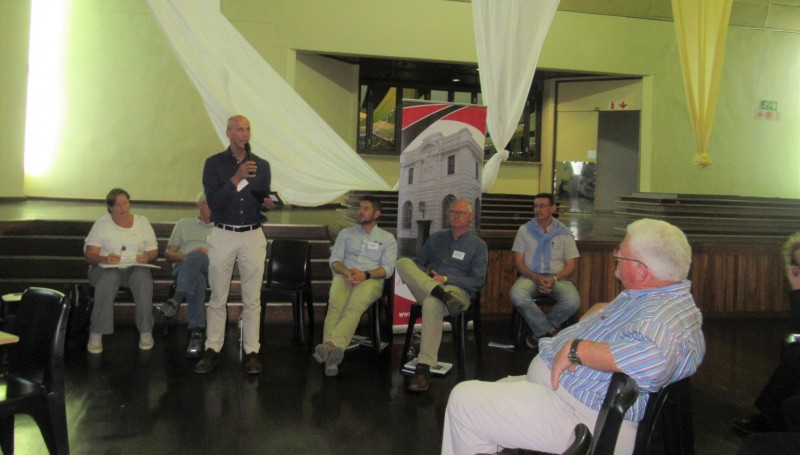
Deon van Zyl, Afro Fishing se bestuurder, aan die woord tydens verlede Woensdag se inligtingsessie en vergadering waartydens 'n paneel kundiges belanghebbendes te woord gestaan het oor Afro Fishing se beplande en hoogs omstrede planne om 'n pelagiese vismeel en olieverwerkingsaanleg in Mosselbaai te vestig. Die vergadering was deel van die openbare deelnameproses wat deur die omgewingskonsultantgroep Cape EAPrac aangebied is terwyl die #fishrot-skandaal besig was om skokgolwe deur die internasionale visbedryf te stuur.
Volgens die Namibiese koerant Die Republikein het Esau en Shanghala hul bedankings ingedien ná 'n vergadering met die Namibiese president Hage Geingob in die nadraai van aantygings oor en ondersoeke na miljarde rande se omkoopgeld van 'n Yslandse maatskappy Samherji om Namibiese viskwotas te verseker.
Volgens internasionale berigte is die Namibiese politici en beamptes wat na bewering tussen 2012 en 2018 Samherji-omkoopgeld ontvang het, mnre. Esau, Shanghala (wat vroeër die prokureur-generaal was), Tamson 'Fitty' Hatuikulipi, wat as konsultant vir SAMHERJI gewerk het, en James Hatuikulipi, die raadsvoorsitter van Fishcor en besturende direkteur van Investec Namibia.
Mnr. Mike Nghipunya, die uitvoerende hoof van Fishcor, word ook geïmpliseer.
Die Yslandse fluitjieblaser, mnr. Jóhannes Stefánsson, wat glo saam met owerhede werk om die beweerde korrupsie oop te vlek, was Samherji se verteenwoordiger in Namibië. Hy is in 2016 afgedank.
Dié skokkende onthullings van grootskaalse korrupsie en geldwassery in die visbedryf om Afrika se seelewe te plunder deur maatskappye met tentakels wat van Angola tot in Cyprus en Dubai strek, het ook tot grootskaalse betogings teen korrupsie in Ysland gelei.
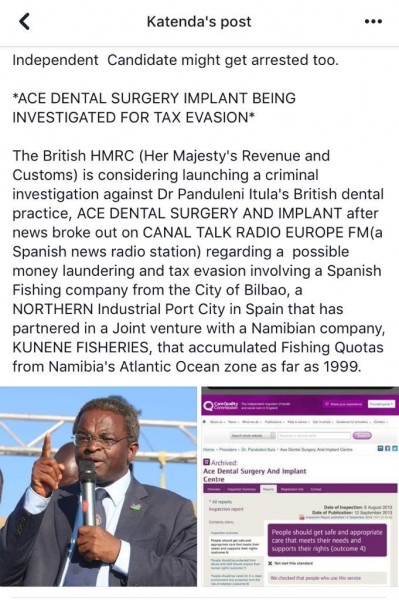
Die #Fishrot-skandaal kring wyd uit en 'n Spaanse vismaatskappye se bande met Kunene Fisheries in Namibië word ook nou ondersoek.
Mosselbayontheline het in vorige berigte onthul dat Afro Fishing se direkteur, Johannes Breed, sedert verlede jaar op die direksie van agt Suid-Afrikaanse maatskappye in die visbedryf dien en dat hy ook die besturende direkteur van African Selection Trust (AST) is. Afro Fishing bestaan reeds sedert 2007, maar het verlede jaar van eienaars verwissel. Vyf van die ses vorige direkteure het in 2018 bedank, terwyl net Shamera Daniels, 'n lid van die Wes-Kaapse seevisserybedryf, aangebly het.
Die nuwe bestuurder, Deon van Zyl, wou vroeër vanjaar nie in 'n openhartige onderhoud met mosselbayontheline sê wie nou Afro Fishing se direkteure is nie. Hy wou ook nie sê waar die R350 miljoen vir Afro Fishing se beplande en uiters omstrede vismeel en olieverwerkingsaanleg vandaan kom nie, behalwe dat dit van oorsese beleggers kom.
Die Namibiese koerant, Namibian, het in Mei 2018 soos volg berig oor Fishcor se vennootskap met African Selection Fishing (ASF) van Adriaan Jacobus Louw:
Fishcor formed a partnership with Adriaan Jacobus Louw, who owns a company called African Selection Fishing Namibia (ASF).
That deal has raised eyebrows in the fishing sector because Fishcor is building a N$500 million factory without going to tender.
A source close to the Central Procurement Board suspects that the Fishcor issue did not go through them because the parastatal was in a partnership.
Intussen is die Suid-Afrikaanse beleggingsmaatskappy INVESTEC ook by die ondersoek betrek:
The Namibia managing director of South African investment firm Investec has resigned after allegations he spearheaded a fishing scheme that generated kickbacks of at least 150 million Namibian dollars ($10 million) in a bribery scandal that has seen two ministers quit.
James Hatuikulipi also resigned as Managing Director of Investec Asset Management Africa, excluding South Africa, while his number two Ricardo Gustavo has been suspended pending the outcome of an ongoing independent investigation, the company said in a statement late on Thursday.The Namibia managing director of South African investment firm Investec has resigned after allegations he spearheaded a fishing scheme that generated kickbacks of at least 150 million Namibian dollars ($10 million) in a bribery scandal that has seen two ministers quit.
James Hatuikulipi also resigned as Managing Director of Investec Asset Management Africa, excluding South Africa, while his number two Ricardo Gustavo has been suspended pending the outcome of an ongoing independent investigation, the company said in a statement late on Thursday.
In 2017, the amaBhungane Center for Investigative Journalism reported that the Namibian fishing industry was outraged because an international interest group, referring to AST, benefited from the allocation of a huge fishing quota to the state-controlled Fishcor. According to the Daily Maverick, the quota comprises 50 metric tons of mackerel per year for 15 years with an estimated value of R120 million per year.
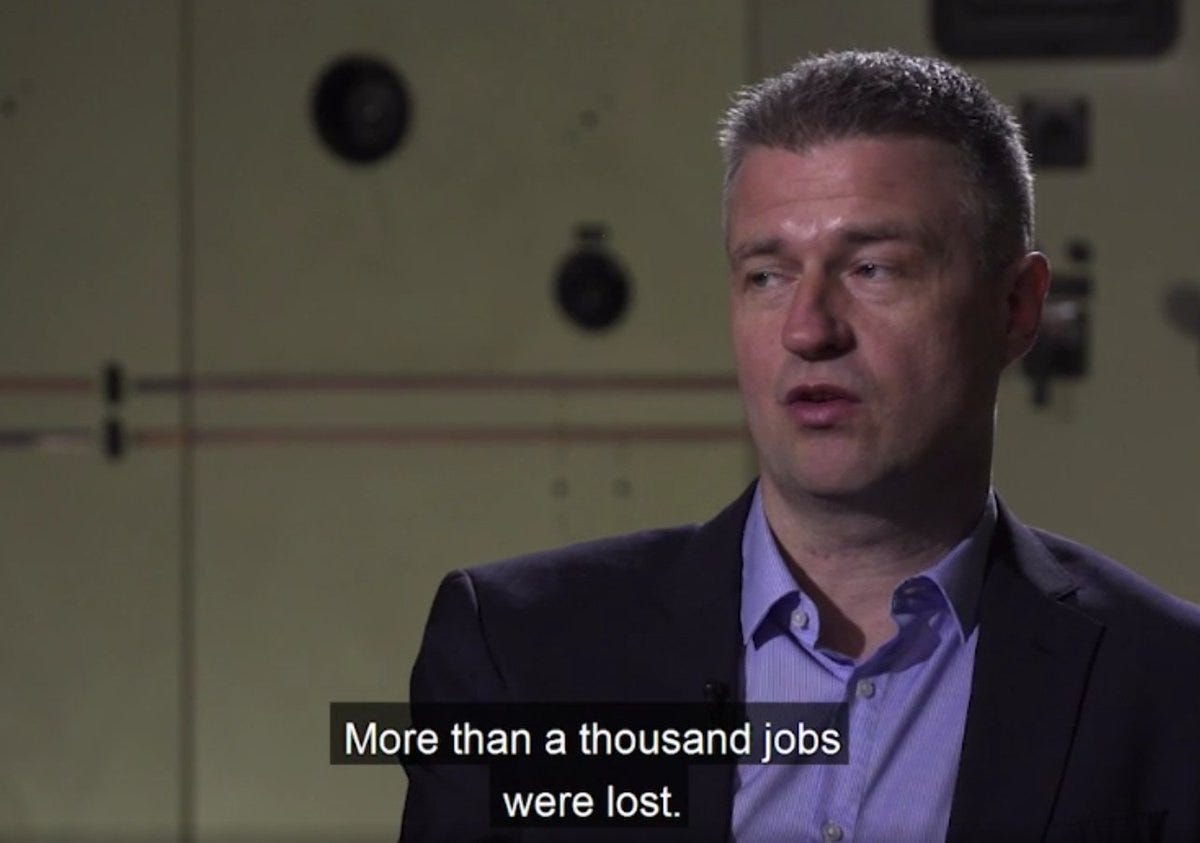
At the time, it was said that at least five Namibian companies could qualify as partners for Fishcor, but were overlooked. At least one, Bidvest Namibia, had to stop its operations in the meantime and about 1 200 people lost their jobs. Seaflower Pelagic has just commissioned a fish factory of nearly R540 million in Walvis Bay. The plant can process as many as 600 tons of mackerel per day.
If Johannes Breed is involved in AST's operations in both Angola and Namibia, then the logical question to ask is whether AST is also the investor behind the R350 million injection in Mossel Bay's Afro Fishing? What is AST's share in the other local fishing companies where Breed also serves on the boards? And what does all this mean for the local fishing industry?
Afro Fishing Managing Director, Deon van Zyl, denies that the company is a subsidiary of AST and was only prepared to say that the money for the Mossel Bay fishmeal factory is a privately acquired investment from abroad.
In Januarie vanjaar het Undercurrent berig Seaflower Pelagic Processing verteenwoordig die grootste belegging in baie jare in die Namibiese visbedryf. Dit beslaan 'n gebied van 14,000 vierkante meter en is reeds die grootste aanleg van sy soort suid van die Sahara en behoort werk aan 420 mense te verskaf.
Namibia’s Fishcor set to open new 70,000t pelagic plant
The National Fishing Corporation of Namibia (Fishcor) is set to begin production at its major new pelagic processing facility in Walvis Bay in the second week of January, reports Informante.
At NAD 350m ($24.3m), the Seaflower plant represents the biggest investment in the Namibian fishing industry for many years. Covering an area of 14,000 square meters, it is already the largest facility of its kind in sub-Saharan Africa, and should employ 420 people.
The vertically-integrated plant consists of ten separate packing lines, each with an average production capacity of six metric tons per hour. The site also includes ten new blast freezers, which can each hold 60t of fish before it is taken to a planned cold storage facility to be held awaiting sale.
Ownership of the Seaflower plant is split between Fishcor, which owns 40%, and African Selection Fishing Namibia, which holds the remaining 60% stake.
Although the plant had been due to open in September 2018, the operating deadline was pushed back to January 2019, ostensibly to coincide with the onset of the horse mackerel fishing season on Jan 1. Fishcor has a 50,000t horse mackerel quota, representing one-seventh of the country's total allowable catch.
Alongside the Seaflower plant, the company has also acquired two Norwegian fishing vessels for NAD 236m ($16.4m). The extra input of raw material provided by the vessels, as well as additional joint ventures with other mackerel quota holders, should bring Seaflower's total annual production capacity to 70,000t.
Lees ook meer hier oor hoe die grootste skandaal sedert Namibië se onafhanklikheidswording nou wêreldwyd ontvou:
Só het ons oor verlede week se Afro Fishing publieke inligtingsvergadering in die Mosselbaai stadsaal berig:
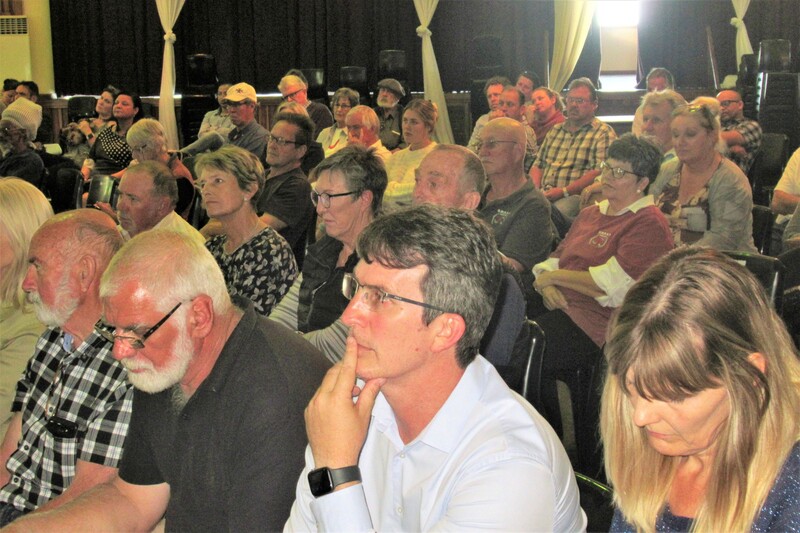
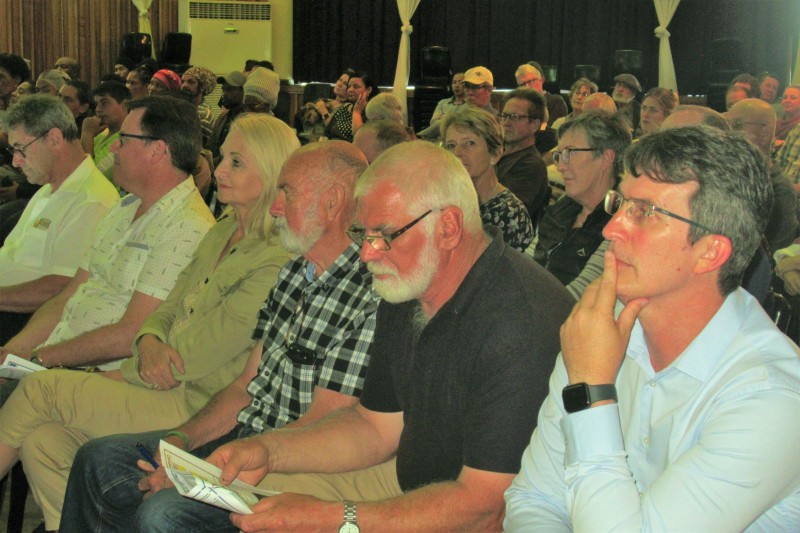
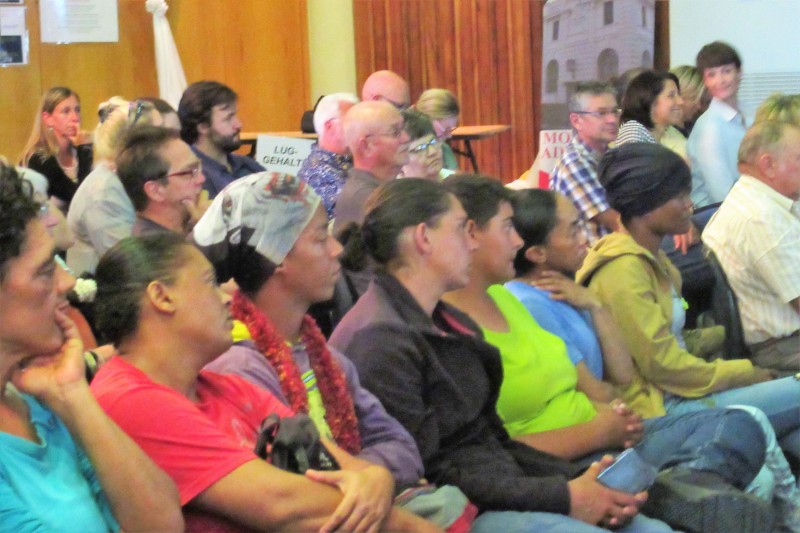
Sowat 200 mense het Woensdag vanaf 16:00 stuksgewys die inligtingsessie en vergadering oor Afro Fishing se omstrede beplande vismeel en -olieverwerkingsaanleg op Kaai 1 in die Mosselbaai-stadsaal bygewoon.
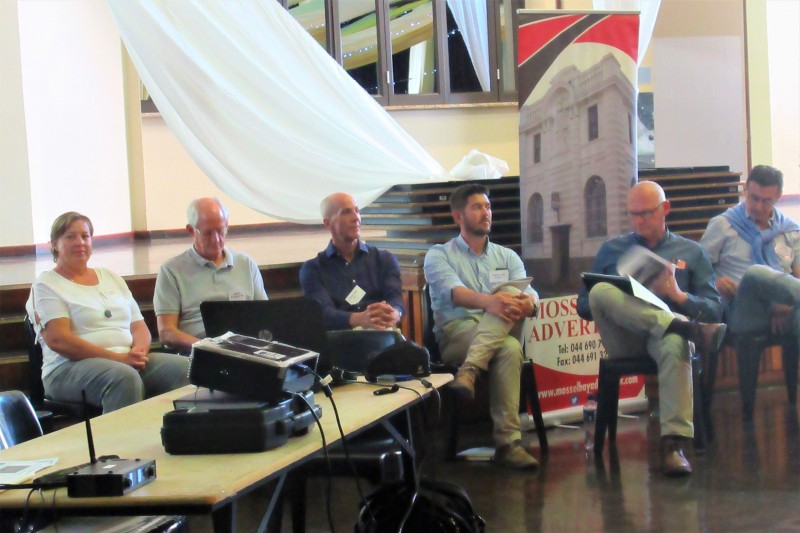
'n Indrukwekkende paneel kundiges het die konsepverslag van die omgewingskonsultantgroep Cape EAPrac. van George verduidelik, waarop die publiek geleentheid gekry het om vrae te vra.
Besware, vrae en vrese oor die oorweldigende en wye impak van só 'n omstrede nywerheid in die kleinste werkende hawe in die land, kon ondanks al die wetenskaplike jargon nie besweer word nie.
Een inwoner het al die besorgdes se vrese in een versoek opgesom: Sal AL die betrokke owerhede (lug- en waterbesoedeling; padverkeer; omgewingsake en vissery, ens.) op skrif onderneem om binne 24 uur alle werksaamhede by die aanleg te staak as dinge nie in die praktyk uitwerk soos (op skrif) beplan is nie ongeag watter faktore die probleme veroorsaak?
Nodeloos om te sê, sal géén owerheid so 'n onderneming op skrif gee nie en berus die suksesvolle implementering, bedryf en bestuur van so 'n vismeelaanleg steeds op al die ASSE:
* AS genoeg VARS pelagiese vis in die omgewing gekry kan word om 1000 ton per dag te voorsien, en daar daagliks verseker kan word dis NET pelagiese vis wat gevang is; (Al die sardyne vir Afro Fishing se sardyninmaakfabriek word al die afgelope twee jaar van Morokko ingevoer weens die afname van dié visspesie in die gebied.)
* AS die viskwotas vir pelagiese vis en totale toelaatbare vangs (TAC) wat nog toegeken en bepaal moet word, voldoende is om in die bedryf te voorsien;
*AS die ingevoerde en gesofistikeerde RTO-stelsel om stank te bekamp (wat vir die eerste keer in SA beproef gaan word) nie probleme gee nie en behoorlik onderhou en bedryf word deur 'n goed-opgeleide span kundiges en toesighouers;
* AS die "wettige toelaatbare vlak" van reuk-, lug- en waterbesoedeling volgens nasionale standaarde ook "aanvaarbaar" is vir inwoners, besighede en toeriste in die nabye omgewing sodat dit hulle nie negatief beïnvloed nie . . . wat selde in die praktyk die geval is, want wie bepaal hoeveel dit mág stink/raas/besoedel soos al jare by Saldanhabaai, Gansbaai, St Helenabaai, Houtbaai, ens. gebeur ONDANKS uitgerekte hofsake, wetgewing en ewe indrukwekkende omgewingsimpakstudies en -voorleggings?
Die konsepverslag kan aanlyn bestudeer word op die webblad www.cape-eaprac.co.za of kan ook op CD of by die biblioteek verkry word.
* Die noodsaaklike lisensies vir omgewingsbesoedeling en atmosferiese luggehalte moet toegestaan word voor enige verdere stappe gedoen kan word. Bg. word onderskeidelik deur die Wes-Kaapse departement van omgewingsake en ontwikkelingsbeplanning onder minister Anton Bredell en die Garden Route Distriksmunisipaliteit uitgereik.
Amid the unfolding bribery and money-laundering scandal that has rocked the local fishing industry, Icelandic captain Arngrimur Brynjolfsonn and Russian Yuri Festison were on Thursday arrested for fishing illegally some 200 nautical miles from the Namibian shoreline. Jade Lennon reported:
Arngrimur Brynjolfsonn is described by Iceland’s state broadcaster as a ‘former Samherji vessel captain’
The two suspects made separate court appearances in the Walvis Bay Magistrate’s Court on Wednesday, where they were charged with fishing illegally in fish breeding areas. Bail was set at N$100,000.
It is understood they were arrested when they docked at Walvis Bay to land their horse-mackerel catches.
Festersson (44) was released on bail but may not leave the bay until the next hearing on 28 November. Brynjolfsonn (67) remains in custody until the N$100,000 bail is paid. He intends to apply for his confiscated passport so he can visit his sick wife in Iceland. His case was postponed to 30 January.
The police did not respond immediately to requests for clarification whether the two captains were in fact employed by Icelandic firm Samherji, which is said to be central to a billion dollar money laundering and international bribery scheme for fishing quotas.
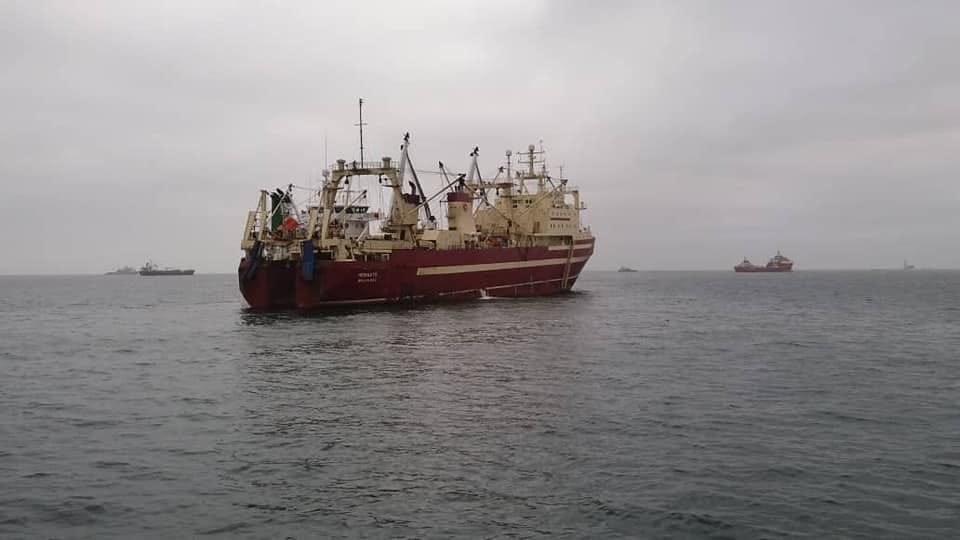
The arrest of the two captain comes after it emerged this week that three massive trawlers belonging to Samherji were still fishing undisturbed in Namibian waters, despite the legality of their operations having been called into question by recent Wikileaks revelations.
Three Samherji vessels, including Heinaste, were spotted in shallow fishing grounds this week still catching.
The disgraced former fisheries minister, Bernhard Esau, and justice minister Sacky Shangala were abruptly forced to resign last Wednesday from their ministerial posts, following explosive revelations of high-level bribery and corruption within the fishing sector amounting to hundreds of millions of dollars — which point to the likelihood that the former ministers will face criminal prosecution.
Impeccable sources close to the Presidency told Confidente that President Hage Geingob had asked for the immediate resignation of the two ministers, who are heavily implicated in what may prove to be the biggest corruption scandal yet uncovered in the history of independent Namibia.
Speculation was rife, following the publication of a massive database and an international investigation supported by Wikileaks, Al Jazeera, Namibian reporters and the daily paper, Stundin in Iceland, that fingered Esau and Shangala as central figures in widespread corruption in the fisheries sector.
It emerged this week that the Icelandic fishing firm, Samherji, allegedly paid hundreds of millions of Namibian dollars in bribes to politicians and related individuals in Namibia to obtain a fishing quota that laid the foundation for much of the company’s billion dollar profits in recent years.
Stundin said a cache of confidential records availed to them in the form of email correspondence, company records, video footage and WhatsApp messages showed how profits and bribes flowed through a network of offshore tax havens into the pockets of politicians and company executives.
The Icelandic paper claimed that Samherji has since 2012 paid hundreds of millions of dollars in bribes to individuals linked to Fisheries Minister Bernhard Esau to secure access to a fishing quota.
“According to documents available about Samherji in Namibia’s operations, large payments, amounting to ISK 2 billion (N$238 million), were made to parties making decisions on fisheries issues on behalf of the Namibian state. In addition to paying bribes, Samherji had set up a website for offshore companies where the company engaged in “capital transfers with low transparency and unclear tax payments”.
FISHCOR IN THE SPOTLIGHT
Sackey Shangala, James Hatuikulipi and Tamson Hatuikulipi during a trip to Iceland.
Stunden said “One of the people who has received payments from Samherji is James Hatuikulipi, chairman of the board of a state-owned company called Fishcor, which among other things distributes quotas to shipping companies in the country. “Another one that has been paid is his nephew, the son-in-law of Fisheries Minister Esau, Tamson Hatuikulipi.”
The third is the disgraced former minister of justice Sacky Shangala, who is said to be one of the pioneers in organising the business, including owning one company that received payment from Samherji.
“The fourth is Mike Nghipunya, CEO of the state-owned company Fishcor, which [the whistleblower] says has received payments from Samherji through intermediaries.”
FISHY TRANSACTIONS
Stundin noted that Samherji is the single largest shipping company in Iceland, factoring in domestic and foreign operations. It generated profits of around N$14.4 billion between 2011 and 2019.
“Part of this huge profit can be attributed to Samherji’s operations in Africa. Samherji’s operation in Namibia makes up about 10 percent of annual income of the Samherji group,” with revenues of close to a billion Icelandic Kroner a year it was estimated.
The deep-going investigation produced evidence that Samherji was in fact paying bribes for quotas in Africa, including through payments to Dubai in the United Arab Emirates from its partner in Cyprus, Esja Seafood, which Stundin said could be called “the centerpiece of the international operation of the Akureyin fishing company”.
“Among other things, Samherji paid over US$4 million, close to half a billion [Icelandic Krone], to a Dubai-based company, Tundavala Investment Limited, owned by James Hatuikulipi, the chairman of the state-owned company Fishcor in Namibia, from 2014 to 2019 to help Samherji’s access to Namibia’s fishing quota in the country and in Angola. Hatuikulipi is a close relative of the son-in-law of Minister of Fisheries Bernhard Esau, ‘Fitty’ Tamson Hatuikulipi. Fitty’s wife, named Ndapandula, is the daughter of Esau.
“The payments were made through Esja Seafood Limited, a holding company and fish company of Samherji in Cyprus, and Noa Pelagic Limited, another Samherji company in Cyprus. Payments from Samherji’s companies to these individuals in Namibia amount to more than half a billion kroner”, (circa N$60 million at today’s exchange rate).
‘CONSULTANCY PAYMENTS’
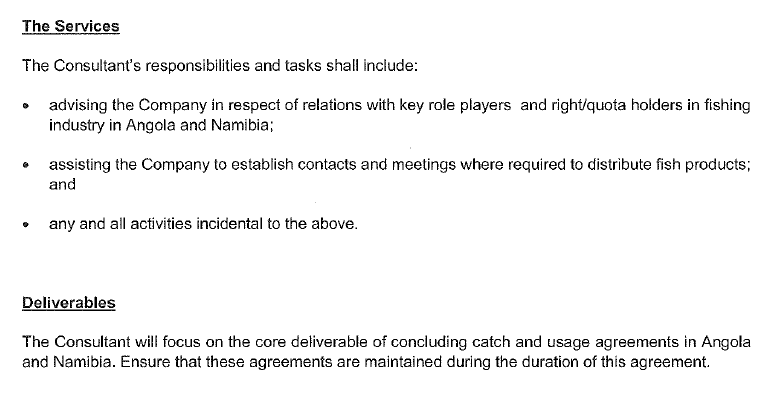
According to the whistleblower, Jóhannes Stefánsson, a former company employee, Samherji paid a bribe for the very first quota the shipping company acquired in Namibia. The payments were called “consultancy payments” at Samherji, but as the former managing director of Samherji in Namibia from 2012 to 2016, Stefánsson says these were in fact bribes.
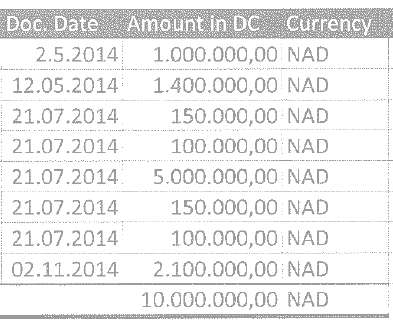
Amounts paid to Tamson Hatuikulipi’s firm Erongo Clearance and Forwarding Services in 2014 total N$10 million.
The agreement Tamson Hatuikulip and Samerhji’s agents.
THE WHISTLE-BLOWER
Jóhannes Stefánsson
Stefánsson said he made the decision to reveal what he knows about the company because he feels bad for Namibia — a poor country with the greatest wealth disparity in the world where about one-fifth of the population live below the poverty line.
Stefánsson, who is assisting the Namibian Police, said of Samherji: “They do not hesitate to bribe and break laws to make the most profit out of the country and leave nothing but … money in the pockets of corrupt parties.” He said he paid money to the minister of fisheries and others in Namibia on behalf of Samherji from 2012 until 2016 when he left the company.
“Payments continued to be received by the Namibians after he left Samherji in July 2016, and the last transfers from Samherji to Tundavala Investments in Dubai, the company of James Hatukulipi, were in January 2019, according to evidence seen by Stundin.
“More than half of the nearly ISK 500 million (N$60 million) bribe paid by two of Samherji’s Cyprus companies to Tundavala Investments, totaling just over ISK 265 million, was paid out after John left Samherji in Namibia in July 2016.”
“Samherji now fishes in Namibia with two to three factory trawlers, Geysir, Saga and or Heinaste, each of which catches 3,500 tonnes of horse mackerel per month. Alongside these tens of billions of revenue, the total bribe amounts to about and more than a billion dollars.”
TAX HAVENS
Stefánsson also claimed that about US$100 million of Samherji’s income in Namibia could not be traced, and suspects that this money was taken out of Samherji, possibly through tax shelters.
“It can therefore be said that a steady stream of money stems from Samherji’s operation in Namibia, as well as from Samherji’s holding companies in Cyprus, such as Esja Seafood, and is in at least three of the world’s tax havens, Marshall Islands, Dubai and Mauritius. In addition, numerous payments are made in large sums to all kinds of offshore companies, including the British Virgin Islands. Little is known about most of these companies.”
Bernhard Esau and Thorstein Má Baldvinsson, CEO of Samherji, at Tamson Hatuikulipi’s house in Windhoek.
No answers were received from Thorstein Má Baldvinsson, CEO and largest shareholder of Samherji, about claims of bribery. When employees of Kveik news asked Baldvinsson about the bribery allegation on October 28, he preferred not to answer questions but spoke instead about the weather. No answers to the bribery were in fact received from two of the largest shareholders and key executives of Samherji. Baldvinsson has reportedly since stood down (or been suspended) from his position as Samherji CEO.
ASKED TO PAY
According to the report, Stefánsson said that in 2012, “Fitty Tamson Hatuikulipi asked him to pay Esau, the minister of fisheries… He claims to have called Aðalstein Helgason, the managing director of Kötla Seafood, who was his immediate supervisor, and asked him about it. “I called Aðalstein and told him that I was to pay the Minister of Fisheries 500,000 Namibian dollars.
“Then Aðalstein told me that whenever I had the opportunity to pay the minister of fisheries, I should pay the minister of fisheries. He somehow put it this way. I took it out in cash and let Tamson have it. Tamson was an intermediary in this. I did this twice.”
He said the minister received personal pay, even though the amounts were small compared to the hundreds of millions of dollars that the data show the three closest to him received from Samherji.
“However, these are the examples of direct payments, as he was supposed to receive them through an intermediary. Whether and how much Bernhard Esau, the minister of fisheries, receives from the hundreds of millions of kroner that the trusts have paid from Samherji over the years is still an issue to be shown or mapped, since the case data does not cover cash payments or their fate,” the report said.
‘I DON’T KNOW ANYTHING’
In secretly recorded video footage obtained by the investigating team, the fisheries minister can be seen negotiating in a hushed voice with what turned out to be undercover Al Jazeera reporters — pretending to be potential investors — at a Chinese restaurant in Windhoek about the payment of “200,000”.
He raises some concern about “money laundering” regulations, about the risk of getting found out and ending up on the front pages of the newspapers. “Yes we want money, but we must be very, very careful,” he famously said. The reporter suggests sending the funds via “Sacky and Sisa”, to which Esau agrees.
Such compromising footage raises concerns that the minister would be vulnerable to blackmail if it were used against him in fisheries-related negotiations.
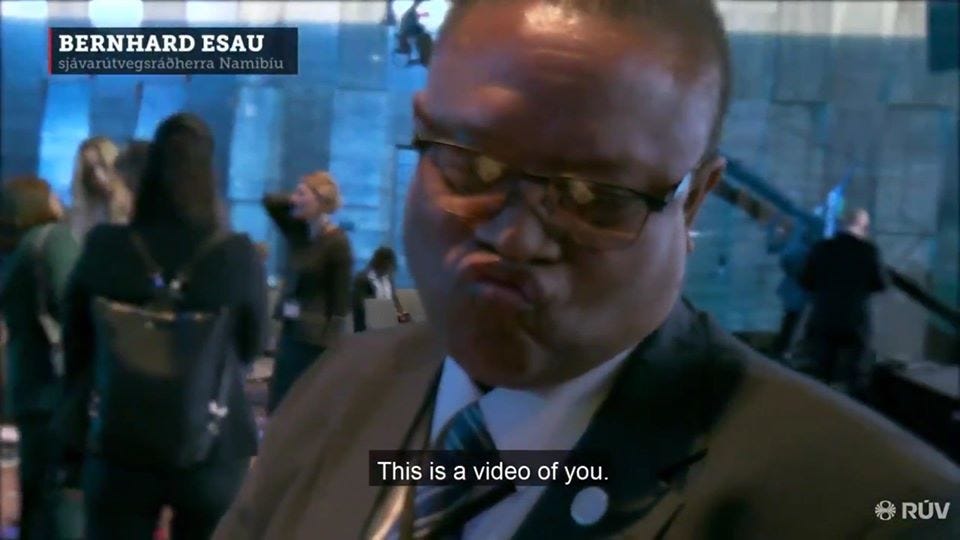
Esau when challenged by Icelandic journalists at a recent summit in Oslo about his involvement with Tundavala Investment Limited — the company owned by Hatuikulipi in Dubai — said repeatedly: “I don’t know, I don’t know anything. Go and investigate some other things. I don’t know the company. I never invited them (Samherji). They came to introduce themselves.”
“What about payments to the company in Dubai, which is owned by James Hautikuilipi?” the reporter pressed.
“I don’t know, I don’t know anything,” the minister persisted.
“Do you know your son in law said he was going to bring money to you?”
“Go investigate some other things,” Esau retaliated. “I don’t know anything.”
Based on the data released by Wikileaks on 12 November, investigative journalist Ingi Freyr Vilhjálmsson concluded that Samherji’s business “strategy in Namibia can be said to have been so successful, partly because the company had ‘political support all along’, secured by hundreds of millions of bribes called consultancy fees.”
NAMIBIAN FISHERIES Minister Bernhard Esau and Justice Minister Sacky Shangala were forced to stand down from their ministerial posts yesterday following explosive revelations of high-level bribery and corruption within the fishing sector amounting to hundreds of millions of dollars, which point towards the likelihood that the former ministers will face criminal prosecution.
Impeccable sources close to the Presidency told Confidente yesterday that President Hage Geingob had asked for the immediate resignation of the two ministers, who are heavily implicated in what may prove to be the biggest corruption scandal yet exposed in the history of independent Namibia.
Speculation was rife yesterday, following the release of a database and publication of an international investigation by Wikileaks, Al Jazeera, Namibian reporters and the daily paper Stundin in Iceland that fingered Esau and Shangala as central figures in multifaceted corruption within the fisheries sector.
Axed Namibian fisheries minister Bernhard Esau being quizzed by a journalist from Iceland on his involvement in the 'Fishrot' saga
It emerged this week that the Icelandic fishing firm, Samherji, paid hundreds of millions of Namibian dollars in bribes to politicians and related individuals in Namibia to obtain a fishing quota that laid the foundation for much of the company's billion-dollar profits in recent years.
Stundin said a cache of confidential records availed to them in the form of email correspondence, company records, video footage and WhatsApp messages showed how profits and bribes flowed through a network of offshore tax havens into the pockets of politicians and company executives.
The Icelandic paper claimed that Samherji has since 2012 paid hundreds of millions of dollars in bribes to individuals linked to Fisheries Minister Bernhard Esau to secure access to a fishing quota.
“According to documents available about Samherji in Namibia's operations, large payments, amounting to ISK 2 billion (N$238 million), were made to parties making decisions on fisheries issues on behalf of the Namibian state.
In addition to paying bribes, Samherji had set up a website for offshore companies where the company engaged in “capital transfers with low transparency and unclear tax payments”.
FISCHOR IN SPOTLIGHT
Stunden said “One of the people who has received payments from Samherji is James Hatuikulipi, chairman of the board of a state-owned company called Fishcor, which among other things distributes quotas to shipping companies in the country.
“Another one that has been paid is his nephew, the son-in-law of Fisheries Minister Esau, Tamson Hatuikulipi.
The third is Namibia's current Minister of Justice Sacky Shangala, who is one of the pioneers in organising the business, including owning one company that received payment from Samherji.
“The fourth is Mike Nghipunya, CEO of the state-owned company Fishcor, which [the whistleblower] says has received payments from Samherji through intermediaries.”
The case is now being investigated in several countries, including Norway.
Stundin noted that Samherji is by far the largest shipping company in Iceland, factoring in domestic and foreign operations. It generated profits of around N$14.4 billion between 2011 and 2019.
Part of this huge profit can be attributed to Samherji's operations in Africa.
Samherji's operation in Namibia makes up about 10 percent of annual income of the Samherji group,” with revenues of close to a billion Icelandic Kroner a year, it was estimated.
The deep-going investigation produced evidence that Samherji was, in fact, paying bribes for quotas in Africa, including through payments to Dubai in the United Arab Emirates from its partner in Cyprus, Esju Seafood, which Stundin said could be called “the centrepiece of the international operation of the Akureyin fishing company”.
“Among other things, Samherji paid over US$4 million, close to half a billion, to a Dubai-based company, Tundavala Investment Limited, owned by James Hatuikulipi, the chairman of the state-owned company Fishcor in Namibia, from 2014 to 2019 to help Samherji's access to Namibia's fishing quota in the country and in Angola.
Hatuikulipi is a close relative of the son-in-law of Minister of Fisheries Bernhard Esau, ‘Fitty’ Tamson Hatuikulipi. Fitty's wife, named Ndapandula, is the daughter of Esau.
“The payments were made through Esju Seafood Limited, a holding company and fish company of Samherji in Cyprus, and Noa Pelagic Limited, another Samherji company in Cyprus.
Payments from Samherji's companies to these individuals in Namibia amount to more than half a billion kroner”, (circa N$60 million at today’s exchange rate).
‘CONSULTANCY PAYMENTS’
According to the whistleblower, Jóhannes Stefánsson, a former company employee, Samherji paid a bribe for the very first quota the shipping company acquired in Namibia. The payments were called “consultancy payments” at Samherji, but as the former managing director of Samherji in Namibia from 2012 to 2016, Stefánsson says these were in fact bribes.
Stefánsson said he made the decision to reveal what he knows about the company because he feels bad for Namibia – a poor country with the greatest wealth disparity in the world where about one-fifth of the population lives below the poverty line.
Stefánsson, who is assisting the Namibian Police, said of Samherji: “They do not hesitate to bribe and break laws to make the most profit out of the country and leave nothing but … money in the pockets of corrupt parties.”
He said he paid money to the minister of fisheries and others in Namibia on behalf of Samherji from 2012 until 2016 when he left the company.
“Payments continued to be received by the Namibians after he left Samherji in July 2016, and the last transfers from Samherji to Tundavala Investments in Dubai, the company of James Hatukulipi, were in January 2019, according to evidence seen by Stundin.
“ More than half of the nearly ISK 500 million (N$ 60 million) bribe paid by two of Samherji's Cyprus companies to Tundavala Investments, totalling just over ISK 265 million, was paid out after John left Samherji in Namibia in July 2016.”
“Samherji now fishes in Namibia with two to three factory trawlers, Geysir, Saga and or Heinaste, each of which catches 3,500 tonnes of horse mackerel per month. Alongside these tens of billions of revenue, the total bribe amounts to about and more than a billion dollars.”
TAX HAVENS
Stefánsson also claimed that about US$100 million of Samherji's income in Namibia could not be traced, and suspects that this money was taken out of Samherji, possibly through tax shelters.
“It can therefore be said that a steady stream of money stems from Samherji's operation in Namibia, as well as from Samherji's holding companies in Cyprus, such as Esju Seafood, and is in at least three of the world's tax havens, Marshall Islands, Dubai and Mauritius.
In addition, numerous payments are made in large sums to all kinds of offshore companies, including the British Virgin Islands. Little is known about most of these companies.”
No answers were received from Thorstein Má Baldvinsson, CEO and largest shareholder of Samherji, about claims of bribery. When employees of Kveik news asked Baldvinsson about the bribery allegation on October 28, he preferred not to answer questions but spoke instead about the weather. No answers to the bribery were in fact received from two of the largest shareholders and key executives of Samherji.
Confidente was not able to obtain on the record responses from the parties involved by the time of going to press, but a statement from the Presidency was expected to be released by Thursday morning.
ASKED TO PAY
According to the report, Stefánsson said that in 2012, “Fitty Tamson Hatuikulipi asked him to pay Esau, the minister of fisheries . . .
He claims to have called Aðalstein Helgason, the managing director of Kötla Seafood, who was his next manager, and asked him about it.
"I called Aðalstein and told him that I was to pay the Minister of Fisheries 500,000 Namibian dollars.
“Then Adalsteinn told me that whenever I had the opportunity to pay the minister of fisheries, I should pay the minister of fisheries. He somehow put it this way. I took it out in cash and let Tamson have it. Tamson was an intermediary in this. I did this twice.”
He said the minister received personal pay, even though the amounts were small compared to the hundreds of millions of dollars that the data show the three closest to him received from Samherji.
“However, these are the examples of direct payments, as he was supposed to receive them through an intermediary.
Whether and how much Bernhard Esau, the minister of fisheries, receives from the hundreds of millions of kroner that the trusts have paid from Samherji over the years is still an issue to be shown or mapped, since the case data does not
cover cash payments or their fate,” the report said.
Esau, Shangala pushed out:
The Anti-Corruption Commission: Paulus Noa
We are busy with investigations. We are looking at many things. What is reported is one part of broader investigations. The allegation is that this was an [quota] agreement between Namibia and Angola and some people to line their pockets.
That is the source of our investigations. It involves a lot of companies (both locally and internationally).
It is a daunting task that is taking up a lot of time. It is a cross-border investigation in collaboration with our counterparts. This is not news to us, what is reported, that is. We have collected documents and we will continue to do more. We have more than what is reported.”
The arrest of the two ministers at this stage will not necessarily guarantee a credible case before court.
The attachment of their properties will be determined by evidence collected in terms of the POCA law (Prevention of Organised Crime).
We cannot do things based on people’s emotions, as this will spoil a good case. A majority of information we gathered was with the help of people from outside the country while local people have a tendency of working in collusion with those suspected of corruption. Had it not been for those sources outside the country, we would not have developed this case to
where it is now. We will continue to collect information to prove whether or not there is a case.
Political commentator
Dr Hoze Ririuako
The issue of corruption is being used by those that are campaigning for Swapo as a yardstick, saying that the government is corrupt because the video clips that we saw (on social media) are very incriminating, while we take cognizance of the fact that the due process in any institutional law system like ours, means nobody is guilty until proven guilty in a competent
court of law.
But, given the gravity of the incriminating clips the President and the party are caught between a rock and hard place because these people are on the list...that will create another paradoxical type of consideration.
Political Commentator
Henning Melber
I think if evidence of large scale corruption is credible enough, a sacking of the two culprits from their current posts is not enough. Then they should be at least for the time being suspended from all offices (including MP status), as long as any investigations and maybe legal proceedings are pending. Their assets should also be seized and frozen until it is established if and how much money they have illegally appropriated, which then should be confiscated and returned to the state.
Given that the President terminated their posts in government with immediate effect, there seems to exist sufficient plausible evidence that they did wrong. Then consequences should be bigger than their mere dismissal from cabinet.
Axed fisheries minister Bernhard Esau
Axed justice minister, Sacky Shanghala
‘I DON’T KNOW ANYTHING’
In secretly recorded video footage obtained by the investigating team, the fisheries minister can be seen negotiating in a hushed voice with Samherji executives at what appears to be his farm about the payment of “200,000”.
He raises some concern about “money laundering” regulations and about the costs of maintaining the farm, which he
said he runs at a loss.
Such compromising footage, observers have said, raise the prospect that the minister was vulnerable to blackmail if it
were used against him in fisheries-related negotiations.
Esau when challenged by journalists at a recent summit in Spain about his involvement with Tundavala Investment
Limited, the company owned by Hatuikulipi in Dubai, said repeatedly:
“I don’t know, I don’t know anything.
Go and investigate some other things. I don’t know the company. I never invited them (Samherji). They came to introduce themselves.”
“What about payments to the company in Dubai, which is owned by James Hautikuilipi?” the reporter pressed.
“I don’t know, I don’t know anything,” the minister persisted.
“Do you know your son in law said he was going to bring money to you?”
“Go investigate some other things,” Esau retaliated. “I don’t know anything.”
Based on the data released this week, investigative journalist Ingi Freyr Vilhjálmsson concluded Samherji's business
“strategy in Namibia can be said to have been so successful, partly because the company had ‘political support all
along’, secured by hundreds of millions of bribes called consultancy fees.”
Icelandic and Russian captains arrested as fishrot scandal deepens
Amid the unfolding bribery and money-laundering scandal that has rocked the local fishing industry, Icelandic captain Arngrimur Brynjolfsonn and Russian Yuri Festison were on Thursday arrested for fishing illegally some 200 nautical miles from the Namibian shoreline.
FISHCOR overpaid for fish factory by N$50m, gets fishing quota worth N$1,8billion that will also benefit Angolan-based partner.
The fish factory ownership will be foreign-dominated since it is managed by a new company called Seaflower Pelagic Processing, a joint venture between Fishcor (40%) and the Angolan-based African Selection Fishing Namibia (60%).
by Ndapewoshali Shapwanale, Shinovene Immanuel
THE state-owned National Fishing Corporation of Namibia (Fishcor) bought a fish factory at the coast for N$160 million in 2016, amid concerns that the parastatal overpaid by as much as N$50 million for the building.
The Namibian reported this week that fisheries minister Bernhard Esau handed Fishcor a fishing quota worth more than N$1,8 billion over a 15-year period. This deal would also benefit an Angolan-based company which partnered Fishcor.
It has turned out that Fishcor did not only get a sweetheart deal from the fisheries ministry, but the parastatal paid N$50 million more on the fish factory that is old.
The details and background of this transaction are included in documents obtained by The Namibian, while seven people who were either involved or directly briefed on this matter, confirmed the details of this deal.
Most of the people did not want to be named because they fear that the fisheries ministry would cut their fishing quotas in retaliation for their comments.
Etale Fishing, which closed in 2013, laying off about 700 workers, owned the property through its subsidiary, Etale Properties.
The sources said Etale Fishing put the factory up for sale in 2015 for N$110 million, which was the valuation of that property. A source said the factory was valued by another valuer at N$90 million in 2015.
Etale Fishing eventually sold the factory in 2015 to well-connected Walvis Bay businessman Jose Luis Bastos, who was a director of Etale at the time.
The exact price paid by Bastos for the factory is unclear, but two people said it was between N$70 million and N$85 million. Bastos then sold the factory to Fishcor the following year for N$160 million.
Bastos declined to comment on the price he bought the property for from Etale.
“I cannot tell you. I don't want to be rude to you, but my business is my business. I sold the property two years ago,” he said.
Fishcor never publicly advertised the tender for buying the fish factory, a decision that would have given the state-owned fishing company better options.
Esau's supporters claim that the minister's decision to spoon-feed Fishcor with 50 000 metric tonnes of fish every year (around N$120 million) is aimed at empowering Namibians.
Some critics have, however, argued that the Fishcor transaction is favouring a state-owned entity that has a history of failing and forcing the closure of private fishing companies which employ thousands of Namibians.
In fact, the new fish factory ownership will be foreign-dominated since it is managed by a new company called Seaflower Pelagic Processing, a joint venture between Fishcor (40%) and the Angolan-based African Selection Fishing Namibia (60%).
One of Etale Fishing's former directors told The Namibian this week that the sale of the factory was “very questionable”, and that the state-owned company must explain and account for the transaction.
“They must explain how they ended up being the buyers of that property,” the former owner-director said, adding that fisheries minister Esau should also explain the purchase of the property.
Esau did not want to comment on Fishcor when approached by The Namibian on Wednesday, saying he can only comment after his ministerial budget discussion was completed in parliament.
As it stands, Fishcor's new partner in Seaflower Pelagic Processing, which is majority-owned by a South African businessman based in Angola, will take up the market left by Etale Fishing and Bidvest Fishing that is expected to close any time soon after reduced quotas.
The former director said the fall of Etale Fishing is a setback to empowerment in Namibia.
“This was the only black-owned processing plant in the country at the time. I cannot even tell you how everything happened. You know when you are standing in the middle of a storm, a real storm, a hailstorm, you don't know what is going on around you, and the next thing you know is everything is over. This is what happened with Etale,” the ex-director said.
Fishcor demolished the Etale factory, but the former owner said the factory had not reached the end of its useful economic life, as claimed by Fishcor.
Fischor plans to build a N$530 million fish factory, but people familiar with the factory said even this amount appears inflated.
The Namibian understands that several Cabinet ministers are nervous about the Fishcor saga.
A person familiar with this matter said Fishcor board chairperson James Hatuikulipi and the parastatal's management briefed the board last year, and some board members visited the plant at Walvis Bay.
DENIAL
Fishcor's chief executive, Mike Nghipunya, told The Namibian last week that the purchase of Etale Properties was a strategic move “as it is the only available piece of land with quay (besides the sea) access”.
WALVIS BAY– The only hope for saving jobs in the pilchard industry is by allocating horse mackerel quotas to United Fishing Enterprises and Etosha Fishing companies.
This was said by the chairperson of the Confederation of Namibian Fishing Associations, Matti Amukwa, and the president of the Namibia Seamen and Allied Workers' Union, Paulus Hango, on Wednesday.
The two companies own fishing rights for pilchard, the fishing of which was barred for the next three years to allow the stocks to recover in an announcement made by information minister Tjekero Tweya on Tuesday.
Approached for comment on Wednesday, Amukwa said the best solution would be to allocate horse mackerel quotas to the two fishing companies so that workers can retain their jobs.
Another suggestion is that the Ministry of Fisheries and Marine Resources arranges with other horse mackerel right holders, for their catches to be processed at United and Etosha Fishing.
Some of the horse mackerel right holders – Namsov Fishing, Kuiseb Fishing and Gendev – do not have land processing factories.
The processing factory at United Fishing closed last year due to low catches, but Etosha managed to sustain its operations by importing pilchard from Morocco, though they still had to retrench some workers.
As such, more than 3 000 employees from the two companies lost their jobs since last year.
Amukwa said it is not clear whether the stock will recover in the next three years and that if it did not, the jobs would remain at risk.
Hango also agreed that horse mackerel canning is the solution.
He, however, said it could be difficult for fisheries minister, Bernhard Esau to give such quotas to companies who do not have rights, considering that the public and right holders could object.
“I personally feel for the people who lost their jobs and those who might follow if this situation is not addressed. Our industry is supposed to create jobs, not to retrench people,” Hango said.
About 600 seasonal and 200 permanent workers are currently employed at United and Etosha Fishing.
Also speaking to the media on Wednesday, managing director of Etosha Fishing, Pieter Greeff said the company will continue to import fish from Morocco and that there would be no job losses next year.
Greeff admitted that there will be no profit as the company will only be paying salaries and other operational costs to stay afloat while monitoring the situation. – Nampa